

The Science of Clinical Trial Data Management
A promising molecule is only as convincing as the dataset behind it. For early-phase biotech, the data management and biostatistics decisions taken at first-in-human shape every regulatory conversation that follows, long before there is a pivotal study to design.
Why data management is the foundation of every trial
Even a small early-phase study generates a dense web of data: dose-cohort assignments, intensive PK sampling, laboratory values, biomarker readouts, adverse event reports, and protocol deviations. With cohorts this small, every observation carries weight, and there is little room to absorb a structural error found late. Without a framework to capture, clean, and govern that data from the first patient, even a well-designed study can produce results a regulator cannot rely on.
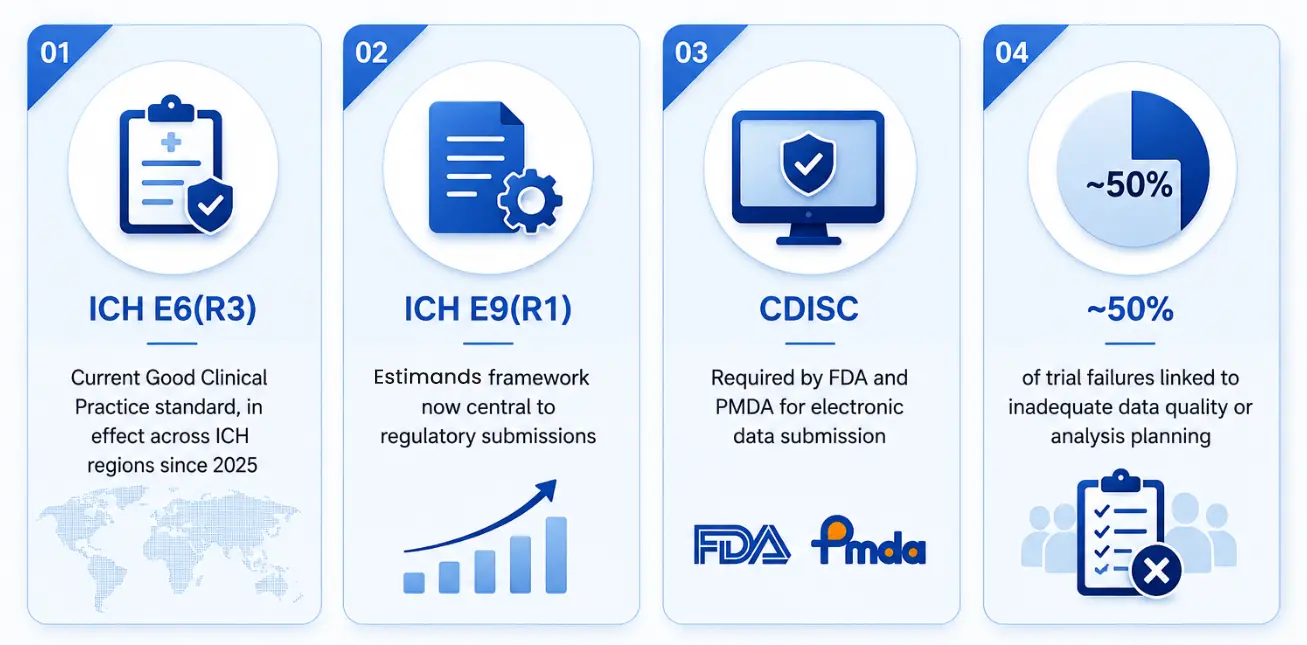
Data management runs the full lifecycle of a single data point: from capture on an electronic Case Report Form (eCRF), through validation and query resolution, to the locked database the statistical analysis depends on. Each stage sits under ICH E6(R3) Good Clinical Practice and the data integrity expectations of the FDA, EMA, and other health authorities. Now in effect across the major regions, the R3 revision puts greater weight on quality-by-design and risk-based oversight, so data quality has to be built in from protocol stage rather than checked for at the end.
“Data quality is not a checkpoint at the end of a trial, it is a continuous discipline woven into every operational decision from protocol design onwards.”
In practice, effective data management depends on:
- Data collection standards built on CDISC CDASH and mapped cleanly to SDTM
- Proactive discrepancy handling with a complete, reviewable audit trail
- Query workflows that resolve quickly without losing traceability
- Data governance documentation that holds up to inspection
With these in place, a sponsor reaches submission with a dataset that holds. Without them, the bill arrives later as database reopenings, audit findings, and timeline slippage, often at the worst moment for a small company with one asset in the clinic.
The critical role of biostatistics in clinical evidence
Statistics is what turns clinical data into evidence. It decides whether an observed effect is real or the play of chance, and regulators read every assumption, model choice, and sensitivity analysis with exactly that question in front of them.
From sample-size justification at design stage to pre-specified analysis plans that guard against bias, biostatisticians shape a trial’s integrity long before the first patient enrols. Their work includes:
-
- Statistical Analysis Plans (SAPs) that fix every primary, secondary, and exploratory analysis in advance
- Randomisation and blinding oversight that keeps selection bias out
- Interim analyses and Data Safety Monitoring Board (DSMB) support
- Submission-ready packages built to CDISC ADaM and eCTD requirements
How Alpha Clinical delivers on both fronts
At Alpha Clinical, data management and biostatistics sit in one team rather than two service lines that meet at handover. The data structures built during collection are designed around the analyses that will use them, which cuts reconciliation work, shortens the path to database lock, and produces a cleaner submission package at the end.
That discipline has a particular source. Alpha Clinical grew up pharmacovigilance-led, so a concern for data integrity and patient safety is built into how the teams work rather than added on top. Most of our sponsors are early-phase biotechs running first-in-human and proof-of-concept studies, often with a single asset and a small internal team, where there is no margin for a dataset that will not withstand scrutiny. We work across the areas where that scrutiny is heaviest: oncology, rare disease, gastroenterology and the microbiome, and neuroscience.
On the data side, that means validated eCRF build, CDASH-conformant standards, and discrepancy resolution that keeps pace with fast-recruiting cohorts. On the statistics side, it means analysis plans written to answer the regulatory question directly, the ICH E9(R1) estimands framework applied where it fits the design, and hands-on support through DSMB reviews and agency interactions. Because the team works across the UK, US, Canada, Singapore, and the UAE, that support follows a sponsor’s studies across time zones and regulatory regions, with work moving forward rather than stalling between one office closing and the next opening.
“The aim is a clean locked database and an analysis package that lands on schedule, answers the regulatory question, and holds up under inspection.”
For an early-phase company, the dataset built now is the foundation every later decision stands on, from the next funding round to the design of a registrational study. Getting it right early is the cheapest insurance a programme can buy.
Ready to discuss your trial’s data strategy?
Contact our team at Alpha Clinical to learn how our integrated data management and biostatistics services can support your next programme.
 Sophia Nematollahi
