

Every medicine carries a story that continues well beyond regulatory approval: how it performs in different populations, how rare events emerge, and how real‑world practice reshapes our view of benefit and risk. Pharmacovigilance provides the structure for following that story, turning disparate reports and data streams into insights that can guide responsible use. When implemented thoughtfully, pharmacovigilance ensures that scientific innovation and patient protection advance together rather than competing priorities.
Today, safety functions are expected to provide meaningful insights throughout the entire product lifecycle, supporting both clinical development and regulatory decision-making. As regulatory expectations continue to evolve and the number of data sources grows, pharmacovigilance has become important. The key question is no longer whether pharmacovigilance matters, but how it can be organised and carried out in an efficient and responsive to real-world practice.
A Lifecycle View of Drug Safety
The transition to lifecycle thinking has redefined the standards of “good” pharmacovigilance. Safety considerations now begin at protocol design, extend through statistical analysis and regulatory submission, and continue into long-term real-world use. A coherent safety narrative connects early signals, clinical trial experience, and post-authorisation data into a single, evolving understanding of benefit–risk. As a result, development partners must look beyond individual studies and consider how each activity contributes to this broader safety narrative over time.
Alpha Clinical Development approaches pharmacovigilance as a continuum rather than a series of isolated deliverables. During early and late‑phase trials, our teams work alongside clinical operations, biostatistics and data management to ensure that adverse event capture, coding and follow‑up are both operationally realistic and scientifically meaningful. Once products move into post‑authorisation stages, that same continuity supports sponsors in maintaining a consistent view of safety across new indications, regions and patient populations. The focus is on preserving context: how each new data point fits into what is already known, and how it informs future decisions. Maintaining this continuity ultimately depends on the quality and interpretability of the safety data that underpin regulatory evaluation and scientific decision-making.
Safety Reporting as Structured Evidence
Safety reporting remains the most visible part of a pharmacovigilance system, but its real value lies not only in timeliness, but in the quality and interpretability of the underlying data. Well-constructed individual case safety reports, consistent medical coding, and clear clinical narratives are essential for credible signal detection and for supporting a product’s benefit–risk assessment.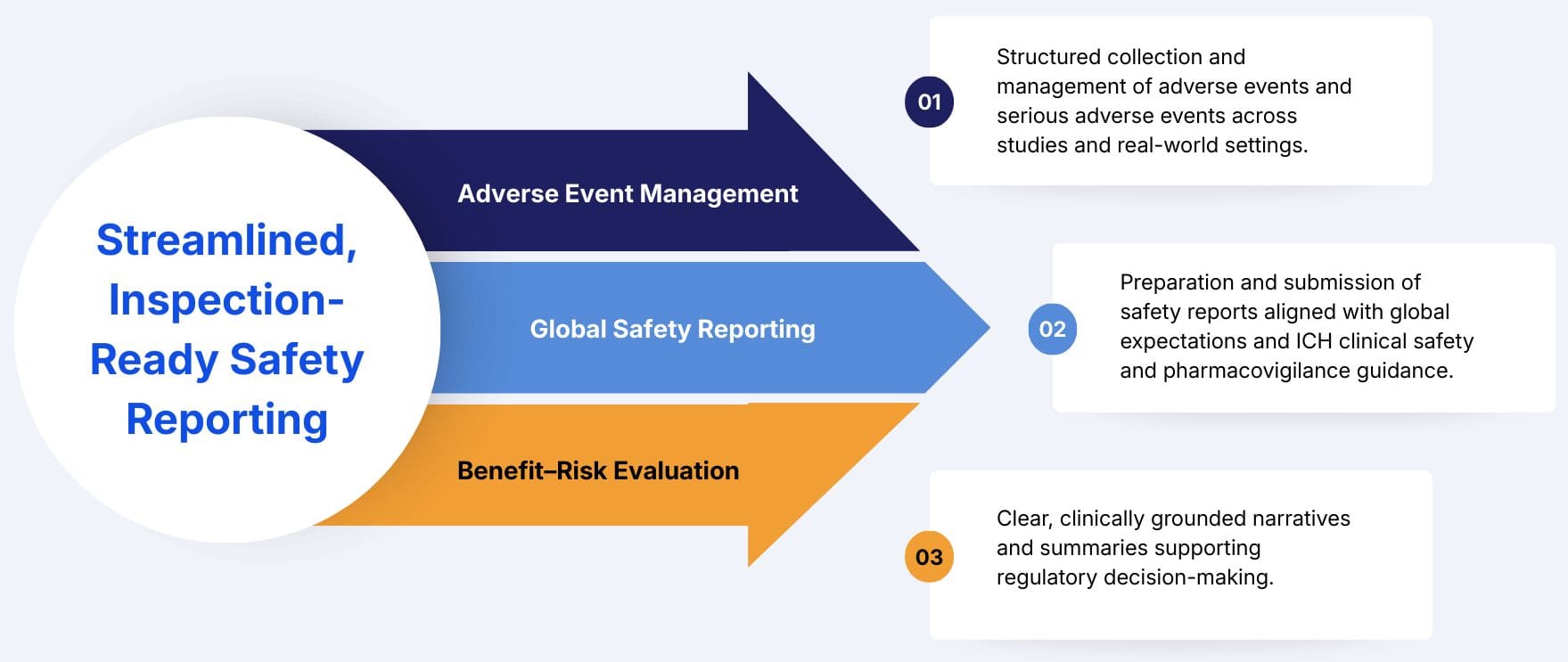
At Alpha Clinical, we structure our safety reporting services around the principle of generating reliable evidence. Case processing is supported by medical oversight, ensuring that seriousness, causality, and outcomes are assessed in contribution with a clear and consistent safety picture. Standardised processes are combined with product- and programme-specific insight so that outputs remain both compliant and relevant to the questions sponsors need to answer. This approach allows safety data to be used confidently in regulatory submissions, inspections, internal governance discussions, and scientific decision-making. In addition, the insights generated through this structured reporting also form the foundation for effective risk management throughout the product lifecycle.
Risk Management as a Continuous Discipline
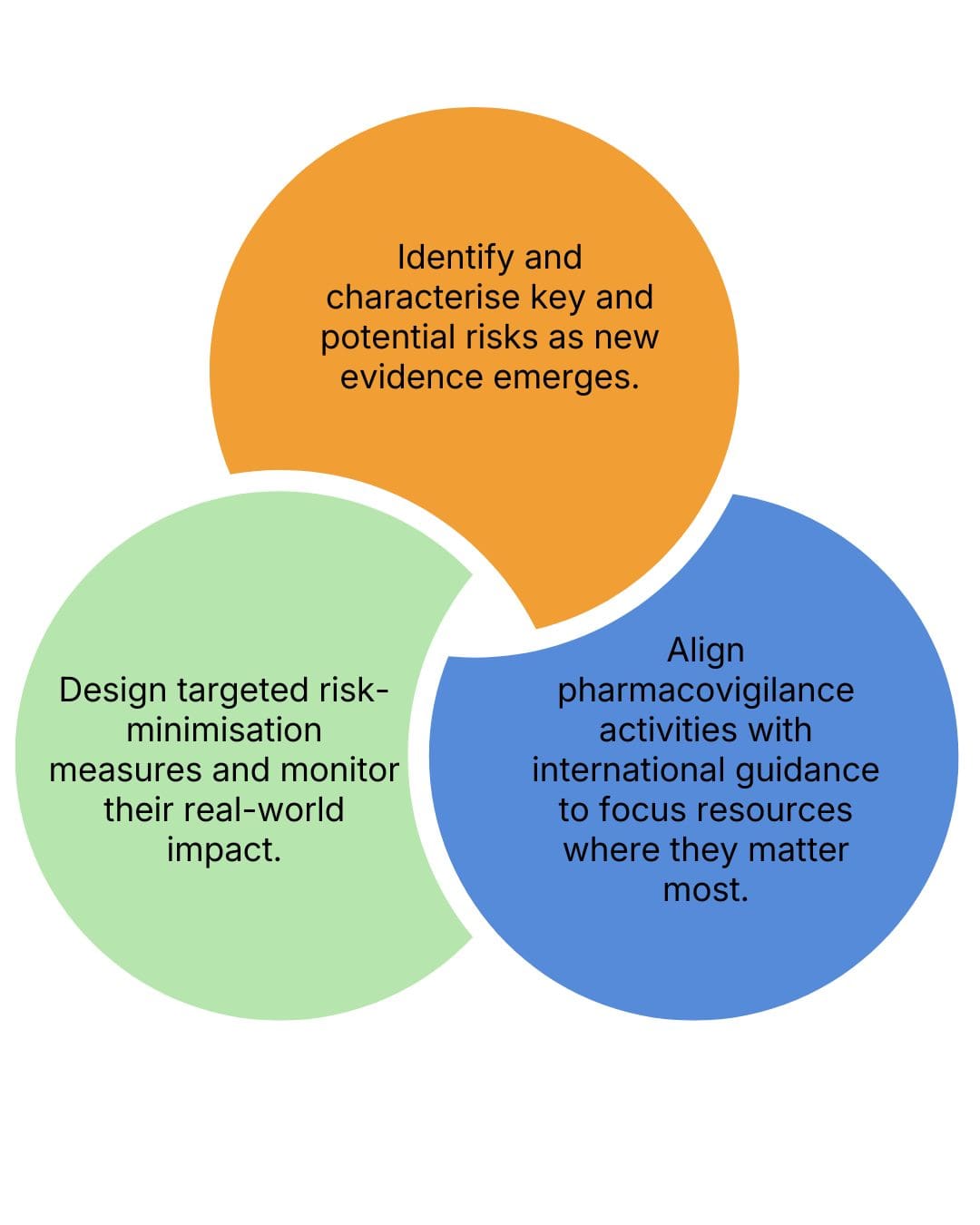 Building on this foundation of structured safety evidence, risk management is understood as a continuous, data-driven discipline rather than a discrete documentation exercise. Key risks and gaps in knowledge must be identified early, monitored, and addressed through risk minimisation measures that are proportionate, operationally feasible and capable of evaluation. Delivering this effectively requires close coordination across clinical development, pharmacovigilance, regulatory affairs and real‑world evidence functions.
Alpha Clinical supports this approach by helping sponsors translate emerging safety data into structured plans and practical strategies. This includes the development and maintenance of risk management plans and periodic safety reports. Attention is given to feasibility in clinical practice and to feedback from ongoing data. Insights from clinical studies and post-marketing experience help refine the approach over time, allowing risk management to evolve alongside the product’s changing safety profile.
Data Integrity and Governance as Foundations
As safety datasets grow in volume, complexity, and diversity, data integrity and governance have therefore become essential foundations of regulatory and scientific confidence. It is no longer enough simply to present results; sponsors must be able to demonstrate how safety data are generated, managed, and controlled throughout their lifecycle.
Alpha Clinical integrates its pharmacovigilance activities within established quality management and governance frameworks. Defined roles and responsibilities, controlled system access, comprehensive audit trails, and documented procedures support the reliability of safety-related data flows, from initial case intake and centralised databases to regulatory submissions. This infrastructure aligns with broader GxP standards while accommodating the needs of multinational programmes and multi-stakeholder collaborations. In doing so, it provides sponsors with confidence that their safety insights are derived from consistent, auditable processes rather than ad hoc measures.
Key focus areas include:
- Transparent and verifiable processes that clearly document the capture, evaluation, and reporting of safety information.
- Clearly defined roles, training programmes, and oversight mechanisms, consistent with EMA Good Pharmacovigilance Practice expectations for organisation-wide pharmacovigilance engagement.
- Harmonised methodologies that meet the requirements of EMA, FDA, MHRA, and other authorities while minimising operational complexity.
A Collaborative Model for Future Ready Pharmacovigilance
Looking ahead, pharmacovigilance will be shaped by expanded real-world data integration, advanced automation and analytics, and closer collaboration with patients and healthcare systems. The challenge is to incorporate these developments without losing sight of core principles: patient protection, scientific transparency and proportionality.
Alpha Clinical addresses this challenge through a collaborative framework for pharmacovigilance. By combining lifecycle safety oversight, structured safety reporting, systematic risk management, and robust governance, we work as an extension of sponsors’ internal teams. The goal is straightforward: to support the delivery of medicines are not only monitored for safety but evaluated and managed in line with regulatory expectations and patient-centred priorities.
 Sophia Nematollahi
