From Discovery to Patient Safety: Making AI Work in Drug Development
 Clinical research and development is entering a period of rapid change. Increasing scientific complexity, evolving regulatory expectations, and rising development costs are pushing organizations to rethink how drugs are discovered, developed, and monitored. Industry analyses and regulatory reviews highlight that AI can shorten timelines, reduce costs, and improve clinical success when built on strong data and operational foundations. For trial sponsors, the question is no longer whether to use AI, but how to integrate it into real clinical programs in a way that is scientifically credible, operationally viable, and inspection-proof.
Where AI adds value across the lifecycle
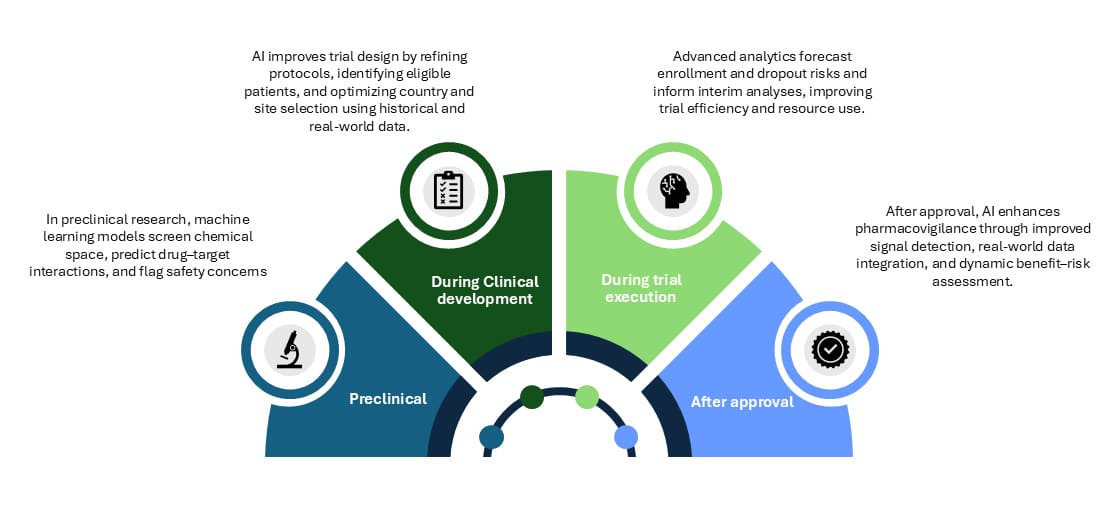
- Early discovery & preclinical: Screens large chemical/biological spaces, predicts drug–target interactions, and flags potential safety concerns early.
- Clinical development: Refines protocols, identifies eligible patients, and optimizes country and site selection using historical trial data, real-world evidence, and disease insights.
- Trial execution: Forecasts enrolment and dropout risks and informs interim analyses to improve efficiency and resource use.
- Post-approval: Strengthens pharmacovigilance through improved signal detection, real-world data integration, and dynamic benefit–risk assessment.
What successful AI in clinical trials looks like
Clinical trials are complex, costly, and highly sensitive to inefficiencies in design, recruitment, and execution, and AI has shown clear value in helping address these pressures. Advanced analytics can support patient identification and recruitment by analyzing electronic health records and real-world data to better match patients to eligibility criteria, reducing recruitment timelines and improving trial diversity.
AI also supports improved trial design and oversight. Predictive modelling helps teams assess protocol feasibility, operational risks, and explore adaptive trial strategies. During trial execution, AI-enabled tools support risk-based monitoring and quality oversight by identifying patterns that signal protocol deviations, data quality issues, or emerging safety concerns, allowing teams to intervene more proactively.
Together, these applications improve trial efficiency, data quality, and the reliability of clinical outcomes. Importantly, success depends on more than algorithms alone. Effective AI use requires well-designed protocols, reliable site conduct, consistent data standards, and clear documentation that regulators can evaluate and trust. Regulators are clear that AI-enabled development must meet the same, if not higher standards of transparency, validation, and oversight as traditional approaches. This is reflected in the FDA’s January 2025 draft guidance on AI-supported regulatory decision-making and the EMA’s July 2023 reflection paper, both of which highlight the importance of data quality, transparency, bias management, and human oversight.
Advancing Pharmacovigilance and Patient Safety with AI
Pharmacovigilance is one of the most active and impactful areas for AI adoption due to the volume and complexity of global safety data, with patient safety remaining a central priority throughout and beyond the drug development lifecycle.
AI strengthens pharmacovigilance by enabling more timely and comprehensive analysis of safety data from clinical trials and spontaneous reporting systems, supporting earlier signal detection, identification of subtle patterns across datasets, and more robust benefit–risk assessments. These capabilities enable more proactive risk management, faster regulatory reporting, and stronger protection of patients, reinforcing confidence in both development programs and approved products. However, to genuinely enhance patient safety, AI must operate within a well-governed PV framework with clear workflows, medical review, and established regulatory reporting practices.
Alpha Clinical’s Perspective on AI-Enabled R&D Support Services
From Alpha Clinical’s perspective, the successful incorporation of AI into R&D support services requires a balanced and structured approach. AI is most effective as a decision-support tool that enhances human expertise rather than replaces it.
Through its clinical operations and R&D operational support services, Alpha Clinical helps design and run studies that generate high-quality, analysis-ready data across multiple geographies and therapeutic areas. This includes feasibility and site selection, start-up coordination, monitoring, and issue management; core processes that ensure AI models are trained on reliable, trustworthy data.

Alpha Clinical views AI as a strategic enabler that can strengthen clinical planning, operational execution, data oversight, and safety monitoring when implemented within strong governance and compliance frameworks. Emphasis is placed on ensuring AI-generated insights are interpretable, validated, and aligned with regulatory expectations. This foundation allows sponsors to adopt advanced analytics and AI platforms without compromising GCP compliance, site workflows, or patient experience.
By combining advanced analytical technologies with deep clinical, regulatory, and operational expertise, Alpha Clinical supports responsible innovation across the R&D lifecycle, helping sponsors leverage AI confidently while maintaining scientific integrity and patient safety.
Partnering with sponsors and AI platforms
Alpha Clinical serves as an implementation partner, working alongside sponsors’ chosen AI tools and platforms. This includes aligning protocol design and operational plans with AI-enabled feasibility and recruitment strategies, coordinating data flows across EDC, eSource, and external analytics platforms, and supporting risk-based monitoring frameworks that leverage AI outputs.
Alpha Clinical also brings medical and regulatory expertise to support the clear communication of AI-derived insights in clinical and regulatory documentation, helping teams describe methods, validation approaches, and limitations in a transparent and regulator-aligned manner. As regulatory continues to clarify expectations for AI in drug development, this combination of operational, scientific, and regulatory capability plays a critical role in de-risking programs.
What’s Next for AI in Drug Development
As AI becomes increasingly embedded across the drug development process, sponsors benefit most from partners who can connect discovery insights with trial execution and post-marketing safety. By combining strong clinical operations, R&D support, and pharmacovigilance capabilities, Alpha Clinical Developments offers an integrated, end-to-end approach that makes AI-driven strategies practical and scalable.
For biotech and pharmaceutical organizations exploring or scaling AI across their portfolios, now is the time to assess whether clinical and safety operations are ready for this next phase. Alpha Clinical is positioned to collaborate with sponsors and technology partners to translate AI’s potential into operational reality and, ultimately, better outcomes for patients.
 Sophia Nematollahi
